
Why High Performers Burn Out Even When They Exercise Regularly

Many ambitious professionals believe regular exercise should protect them from burnout. They train consistently, stay active, follow structured routines, and try to maintain healthy habits even during stressful periods. From the outside, they often look disciplined, productive, and physically healthy. Yet many still feel mentally exhausted, emotionally drained, and constantly overwhelmed.
That contradiction is far more common than most people realize.
The reality is that exercise alone does not automatically prevent burnout in high performers. Someone can stay committed to workouts while still struggling with chronic stress, poor recovery, emotional exhaustion, and long-term performance fatigue. Many professionals continue pushing themselves physically while their nervous system remains overloaded by pressure, responsibility, constant mental stimulation, and lack of proper recovery.
That imbalance explains why so many people experience burnout despite exercise. The issue is often not discipline or motivation. More often, it is the growing gap between stress and recovery.
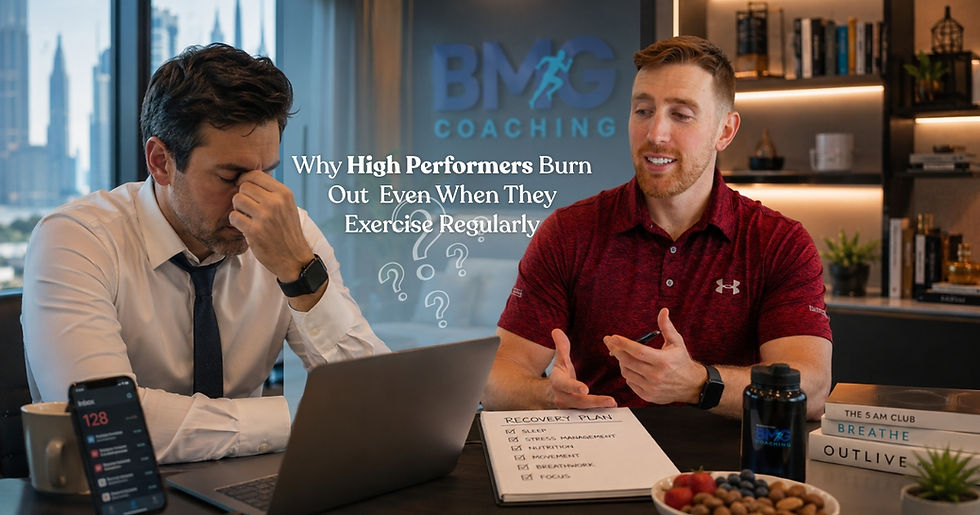
Why Do High Performers Burn Out Even When They Exercise?
One of the biggest misunderstandings around modern wellness is the belief that workouts automatically create balance.
Exercise can absolutely support physical and mental health, but it cannot fully offset constant pressure, poor sleep quality, emotional stress, overstimulation, or unhealthy work patterns. Someone may train consistently and still experience executive burnout, low energy, mental fatigue, emotional exhaustion, and difficulty recovering physically or mentally.
Many ambitious professionals operate in environments that reward constant output. Their schedules stay full, their minds rarely slow down, and recovery becomes something they try to fit in after everything else is finished.
Over time, that lifestyle creates stress overload.
Many professionals eventually begin asking questions like: “Why am I exhausted even though I exercise?” “Why do high achievers burn out?” “Can you burn out while exercising regularly?” “Why is exercise not fixing my fatigue?”
In many cases, those questions are not signs of weakness. They are signs that recovery has been neglected for too long.
Burnout Usually Builds Slowly, Not Suddenly
Burnout rarely appears overnight. Most professionals drift into it gradually while continuing to function at a high level.
At first, the changes seem small. Sleep becomes lighter. Recovery from workouts takes longer. Focus becomes inconsistent. Energy feels unstable throughout the day. Motivation outside of work slowly fades.
Because many high performers are used to functioning under pressure, they often normalize these warning signs instead of recognizing them.
That is one reason high achievers' burnout becomes difficult to identify early. Someone may continue performing professionally while quietly becoming emotionally depleted underneath the surface.
A person can still appear productive while carrying long-term stress that slowly reduces recovery capacity. This is where many professionals get trapped. They continue pushing through exhaustion because they assume productivity means they are still functioning well. Meanwhile, the nervous system continues absorbing stress even when someone appears outwardly successful.
Eventually, many professionals notice they no longer feel properly recovered, even after resting.
Why Chronic Stress Changes Recovery
The relationship between chronic stress and recovery is one of the most overlooked areas in modern wellness.
When stress remains elevated for long periods, the nervous system struggles to fully reset. The body stays in a constant state of alertness, even during rest. Sleep quality often declines, mental recovery becomes incomplete, emotional resilience weakens, and physical recovery slows down.
That is why some professionals continue exercising consistently while still feeling exhausted.
The problem is not always the workout itself. More often, it is the total stress load being carried every day.
Work pressure, constant decision-making, emotional tension, digital overstimulation, poor sleep, and lack of downtime all affect the body’s ability to recover. When that stress continues building without enough recovery, the nervous system eventually becomes overloaded.
At that point, even healthy habits stop feeling restorative. This is one reason many professionals experience low energy despite exercise. Their body is still spending most of its energy trying to manage stress instead of fully recovering from it.
Exercise and Burnout Are More Connected Than Most People Realize
A lot of people assume burnout only happens to individuals who completely neglect their health. In reality, someone can exercise consistently and still struggle with mental fatigue, poor recovery, chronic fatigue, emotional exhaustion, and long-term sustainable performance problems.
This is why exercise and burnout need to be understood together instead of separately.
Exercise itself is a physical stressor. Under healthy conditions, the body adapts positively to that stress. But when someone is already carrying excessive work stress, emotional pressure, poor recovery habits, and ongoing nervous system overload, additional intensity can sometimes increase exhaustion instead of improving wellbeing.
That does not mean exercise is harmful. It means recovery must match the level of stress someone is carrying.
Many high performers continue adding more intensity because they believe discipline alone will fix the problem. They train harder, push longer, and try to optimize every routine while ignoring the deeper recovery imbalance underneath everything else.
Eventually, the body starts demanding recovery in ways that become harder to ignore.
Why High Performers Ignore Burnout Symptoms
Many ambitious people unintentionally build their identity around productivity, discipline, and constant performance. Slowing down can begin to feel uncomfortable because rest becomes associated with falling behind.
Over time, that mindset creates problems.
A lot of successful professionals become extremely skilled at functioning while exhausted. They continue managing responsibilities, attending meetings, training consistently, and maintaining routines while quietly feeling emotionally disconnected and mentally drained.
That is one reason burnout symptoms are often ignored for too long.
For many professionals, the early warning signs appear through subtle changes. Sleep feels less restorative. Recovery from workouts becomes slower. Stress feels constant even during quiet moments. Emotional patience weakens. Motivation outside of work disappears. Small tasks begin feeling mentally heavier than usual.
Instead of improving recovery, many simply push harder.
Unfortunately, that approach usually worsens recovery imbalance and increases long-term exhaustion.
Why Recovery Matters More Than Most Professionals Realize
One of the biggest informational gaps in modern wellness content is the lack of discussion around recovery management.
Most people focus heavily on productivity, training intensity, diet plans, and performance optimization while treating recovery like an afterthought. But long-term sustainable performance depends heavily on recovery quality.
Without proper recovery, stress accumulates faster than the body can adapt.
That affects focus, emotional regulation, sleep quality, physical recovery, mental recovery, creativity, decision-making, and long-term consistency.
This is why recovery psychology matters so much for professionals living under constant pressure.
Someone cannot continuously perform at a high level without giving the nervous system enough opportunity to recover properly. Recovery is not laziness, weakness, or lack of ambition. It is part of sustainable performance.
Many professionals eventually realize they do not need more intensity. They need healthier systems that allow the body and mind to recover consistently.
Why Healthy Habits Sometimes Stop Feeling Effective
Many professionals become frustrated because they are doing “healthy” things, but still feel exhausted.
They are exercising regularly, trying to stay disciplined, and maintaining structured routines. Yet they still feel mentally drained, emotionally overloaded, and physically fatigued.
That experience is real. When someone lives under long-term stress, the body’s recovery systems eventually become overwhelmed. In that state, workouts may no longer create the same positive effect they once did because the nervous system is already overloaded before the workout even begins.
That is one reason stress and burnout often continue even in people who appear physically healthy.
The body does not only respond to workouts. It also responds to work pressure, emotional stress, sleep quality, lifestyle imbalance, recovery habits, mental stimulation, and work-life balance.
If those areas remain overloaded, exercise alone cannot fully restore long-term energy or well-being.
Sustainable Performance Requires Healthy Systems
One of the biggest mistakes in modern performance culture is treating intensity as the solution to everything.
In reality, long-term health and sustainable performance usually come from healthier systems, not constant intensity.
That includes:
deeper and more consistent sleep
smarter recovery practices
stronger emotional reset periods
routines that remain realistic during stressful weeks
healthier professional boundaries
better stress management
a more balanced lifestyle structure
consistent support systems
Without those foundations, many professionals eventually become trapped inside a cycle of constant output with limited recovery.
This is why sustainable health requires balance instead of extremes. Someone can maintain intensity temporarily, but long-term well-being depends on whether the body and mind can realistically recover from the total stress load being carried every day.
Why Executive Wellness Requires a Different Approach
Generic wellness advice often fails busy professionals because it ignores the reality of high-pressure lifestyles.
Many executives and ambitious professionals, especially those working in fast-paced environments like Dubai and the UAE, are managing long work hours, constant decision-making, mental overload, travel schedules, performance pressure, digital overstimulation, and limited recovery time.
This is why executive wellness and professional wellness require a more realistic approach. Most professionals do not need more pressure added to their lives. They need healthier systems that support long-term consistency and recovery even during stressful periods.
This is where executive health coaching, performance health coaching, and structured accountability become valuable.
A sustainable approach focuses on stress resilience, energy optimization, recovery strategies, sustainable routines, healthier boundaries, and long-term consistency instead of relying on short bursts of motivation or extreme routines.
That approach is far more realistic for busy professionals trying to maintain both performance and well-being long term.
Why Recovery Is Essential for Long-Term Performance
Many high performers focus heavily on output but underestimate how much recovery affects performance itself.
Poor recovery eventually affects focus, emotional control, creativity, decision-making, energy levels, sleep quality, workout recovery, and overall professional performance.
This is why executive energy management matters so much.
Someone may continue functioning professionally for a long time while carrying hidden exhaustion underneath the surface. But eventually, performance usually starts declining if recovery remains ignored.
Sustainable performance is not built through constant intensity alone. It is built through healthier systems that support both performance and recovery.
That balance is what many professionals are missing.
Final Thoughts
So, why do high performers burn out even when they exercise regularly?
Because exercise alone cannot fully protect someone from chronic stress, poor recovery, emotional exhaustion, nervous system overload, and long-term performance pressure. Many ambitious professionals continue functioning while their body and mind remain stuck in a constant state of stress without enough recovery to fully reset.
Over time, that imbalance creates fatigue, burnout symptoms, reduced recovery capacity, declining energy, and emotional exhaustion even in people who appear healthy externally.
Real long-term wellbeing is not built through workouts alone. It is built through sustainable systems that support recovery, stress management, consistency, sleep quality, emotional well-being, and healthy routines together.
If you constantly feel exhausted despite exercising, struggle with recovery, or feel trapped between performance and wellbeing, the issue may not be a lack of discipline. It may be the lack of recovery your body and mind genuinely need.
Visit Barry McGinley Coaching to explore performance-focused health coaching designed for busy professionals and high performers in Dubai and the UAE who want sustainable energy, healthier recovery, structured accountability, and long-term wellbeing without relying on burnout-driven routines or extreme health approaches.
Frequently Asked Questions
Can you burn out even if you exercise regularly?
Yes. Exercise supports overall health, but it cannot fully offset chronic stress, poor recovery, emotional exhaustion, or constant performance pressure over long periods of time. This is why many professionals still experience burnout despite exercise.
Why am I exhausted even though I work out consistently?
Many people experience low energy despite exercise because stress, poor sleep quality, mental overload, and recovery imbalance can overwhelm the nervous system and reduce recovery capacity.
Does exercise prevent burnout?
Exercise can help improve well-being and support stress management, but it does not automatically prevent executive burnout if recovery, sleep, and long-term stress management are consistently neglected.
Why do high performers burn out more easily?
Many high achievers normalize stress, push through exhaustion, and prioritize productivity over recovery. Over time, that mindset can increase emotional exhaustion, performance fatigue, and long-term burnout risk.
What are common burnout symptoms in professionals?
Common burnout symptoms include mental fatigue, emotional exhaustion, poor recovery, disrupted sleep, low motivation, constant stress, reduced focus, and difficulty maintaining healthy routines.
Why does recovery matter for long-term performance?
Recovery helps the body and mind reset from stress. Without proper recovery management, long-term stress can reduce focus, emotional resilience, energy levels, and overall professional performance.


Comments